
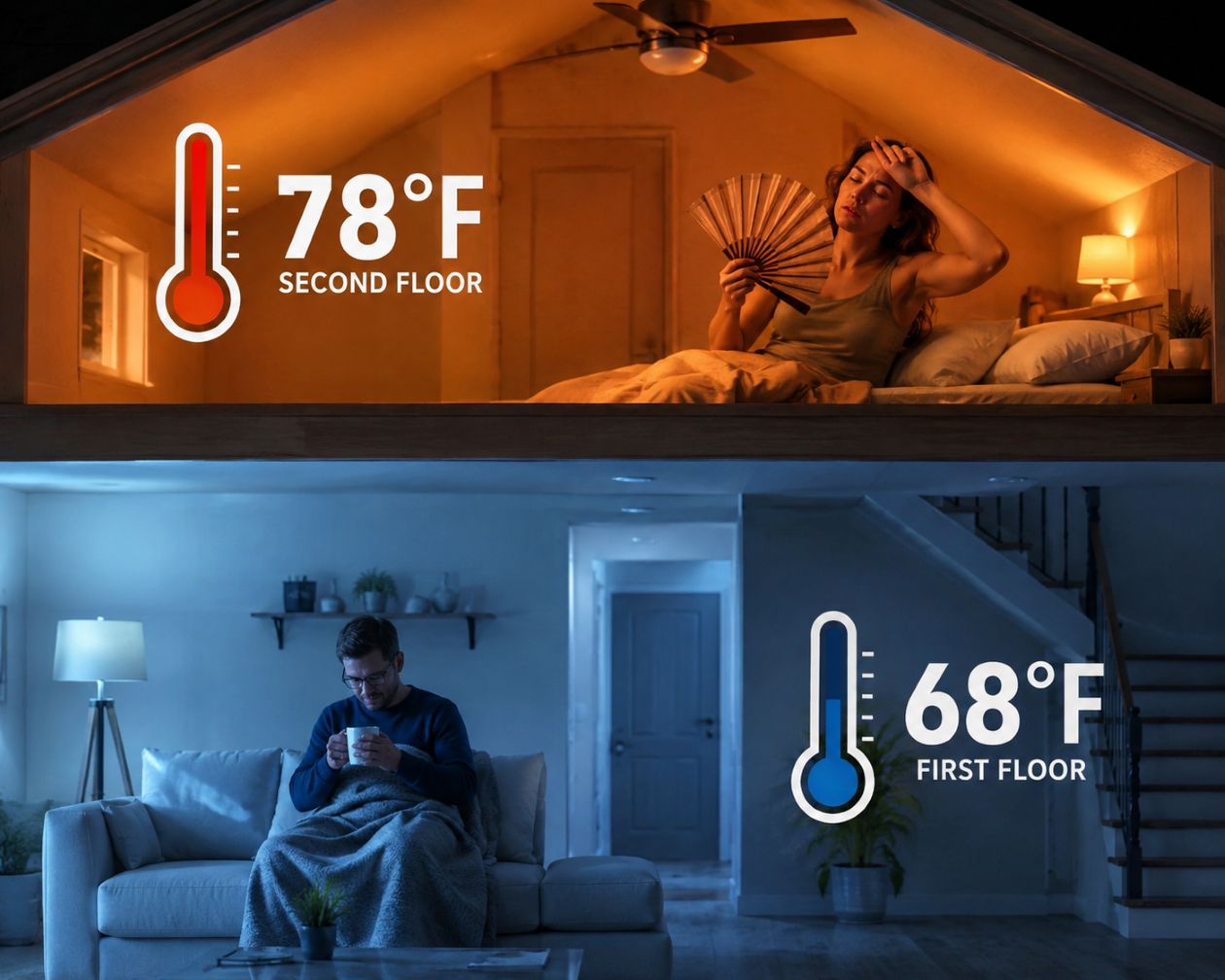
You set the thermostat to a comfortable temperature, your air conditioner kicks on, and the main floor feels great. Then you walk upstairs and immediately wonder, “Why is my second floor so hot?”
Uneven cooling is a common issue in two-story homes, especially during the summer. While a slight temperature difference between floors is normal, a second floor that’s always hot can point to problems with airflow, insulation, ductwork, or your HVAC system.
If you’ve been googling “why is my upstairs hot and downstairs cold,” this guide is for you. The HVAC experts at Comfort Zone Services will be breaking down what causes uneven cooling in a house, what you can do about it, and when it might be time to call a professional.
Why Is My Upstairs Hot and Downstairs Cold?
Below are the most common reasons behind a hot upstairs and cold downstairs. It could be one or a combination of factors.
1. Warm Air Naturally Rises
Let’s start with a brief physics refresher. Hot air is lighter than cool air. Add gravity into the mix, and that’s why warm air rises in your home, while the denser cool air tends to settle on lower floors.
That means even without an HVAC problem, a two-story home will usually be a bit warmer on the second floor. Your air conditioner has to work hard against this natural movement of heat to maintain a consistent temperature throughout the house.
During the summer, the effect can become even more noticeable because the second floor also gains heat from the roof, attic, and upstairs windows.
2. Your Attic May Be Adding Heat
Speaking of your attic, if your second floor is hot in summer, it could be the culprit.
Your roof absorbs heat from the sun throughout the day, which can significantly increase the temperature inside your attic. Without adequate insulation and ventilation, some of that heat will enter the rooms directly below.
Insulation works both ways too. It not only helps prevent outdoor heat from entering your living space, but proper insulation also keeps the conditioned air inside.
Poor attic insulation can therefore make your upstairs warmer while forcing your AC to work harder to compensate.
3. Your Upstairs Isn’t Getting Enough Airflow
If you have central air and your second floor is hot, inadequate airflow may be part of the problem. Your HVAC system has to deliver enough cool air to the second floor while, at the same time, allowing the warm air to return to the system so it can be released outside.
Several things can interfere with that process, including:
- Dirty HVAC filters
- Blocked supply or return vents
- Poorly designed ductwork
- Inadequate return airflow
- Incorrectly adjusted dampers
- An HVAC blower that isn’t performing properly
4. Your Ductwork Is Leaking
Your ducts are responsible for carrying conditioned air from your AC to the rooms throughout your home. If those ducts are leaking, damaged, poorly insulated, improperly sized, or incorrectly installed, some of that cool air never makes it upstairs.
Instead, cool air can escape into spaces such as your attic, basement, or wall cavities. Poor duct design can also mean that certain rooms simply don’t receive enough airflow in the first place.
If your AC leaves the second floor hot no matter how low you set the thermostat, consider having your ductwork inspected.
5. Your HVAC Dampers Need Adjusting
Some duct systems contain dampers, which are generally preset by the installer, that control how much air travels through different branches of the ductwork.
Unfortunately, as your HVAC system gets older and becomes less efficient, or in cases of extreme weather, the original damper settings might no longer be effective.
If you have manual dampers, you’ll probably see a section of metal tubing with a lever that’s in line with your ductwork. You can use the lever to adjust the airflow through that duct. By sending slightly more air upstairs and a bit less downstairs, it can help create a better temperature balance in your home.
However, resist the temptation to just close a bunch of downstairs vents. Closing vents can disrupt the airflow your HVAC system was designed to handle and potentially make the system work harder instead of solving the underlying problem.
6. One Thermostat Is Trying to Control Two Floors
Here’s another common problem: your thermostat thinks your house is perfectly comfortable.
If your thermostat is located downstairs, it measures the temperature around that thermostat. Once the main floor reaches your set temperature, the system will stop cooling, even though the bedrooms upstairs are still several degrees warmer.
Traditional single-zone HVAC systems treat the entire house as one space, which can make maintaining consistent temperatures across multiple floors difficult.
7. Your AC Is Aging or Improperly Sized
If your home used to cool evenly and you’ve noticed that the problem is getting progressively worse, your HVAC equipment itself likely needs attention.
As systems age, declining performance makes it harder to maintain consistent temperatures throughout a larger or multi-story home. An improperly designed or sized HVAC system can cause similar comfort problems.
This doesn’t automatically mean you need a new air conditioner. A professional inspection can determine whether maintenance or repairs could restore performance or whether it’s worth thinking about replacing your system.
5 Hot Second Floor Solutions You Can Try
Before assuming you need major HVAC work, here are a few simple things you can try to help your second floor stay cooler:
1. Change Your HVAC Filter
At the risk of sounding like a broken record, check your filter first. A clogged filter restricts airflow and makes it harder for your HVAC system to circulate cool air effectively.
How often you need to change your air filter depends on the type of filter, your HVAC system, your indoor air quality, and how heavily your AC is being used.
2. Keep Vents and Returns Clear
Make sure furniture, rugs, curtains, and other objects aren’t blocking your upstairs supply and return vents.
And again, don’t close downstairs vents in an attempt to force cool air upstairs. Your duct system should be properly balanced instead.
3. Close Upstairs Blinds During the Day
Close curtains or blinds during the hottest part of the day to reduce solar heat gain. You can also try heat-blocking shades.
4. Use Your Ceiling Fans
Ceiling fans won’t actually lower the room temperature, but they circulate air and create a cooling effect that can make upstairs rooms feel much more comfortable.
During summer, make sure your ceiling fan is rotating counterclockwise, which creates a cool breeze and can even help to reduce energy costs.
5. Consider Running Your HVAC Fan
Using your thermostat setting to keep your HVAC fan on even when the air conditioner isn’t engaged can help mix the air between floors and reduce temperature differences.
Keep in mind that continuously running the fan isn’t necessarily the best strategy for every HVAC system or home. Ask your HVAC technician about the ideal thermostat and fan settings for your equipment.
What To Do When Simple Fixes Aren’t Enough
If your second floor is always hot in spite of trying the basics, it could be time to address the root cause.
Depending on your home, there are several potential solutions.
Have Your Ductwork Inspected
An HVAC technician can assess your ductwork for leaks, damage, airflow problems, and other issues that could be preventing enough conditioned air from reaching your second floor.
Improve Attic Insulation and Ventilation
If excessive attic heat is contributing to the problem, improving insulation, air sealing, or ventilation may help keep that heat from transferring into your second-floor living space.
Think About HVAC Zoning
For homes where different floors consistently have different heating and cooling needs, zoning can be an effective long-term solution.
A zoned HVAC system divides your home into separate areas that can be controlled independently. Motorized dampers inside the ductwork adjust airflow based on what each zone needs rather than treating the entire house as one space.
For example, your upstairs bedrooms could be one zone while your main living area is another.
Instead of overcooling the downstairs just to make the upstairs comfortable, the system can direct cool air where it’s actually required.
Add a Ductless Mini Split
Sometimes the existing central AC works well for most of the house but can’t keep a particular upstairs area comfortable.
In that situation, a ductless mini split can provide supplemental cooling without requiring major modifications to your existing ductwork. Mini splits can be particularly useful for bedrooms, converted attics, additions, and other difficult-to-cool areas.
Upgrade Your HVAC System
If your current equipment is aging, inefficient, or isn’t properly suited to your home’s needs, replacing your air conditioner might be the best option.
However, bigger isn’t automatically better. Your HVAC contractor should evaluate your home and cooling requirements before recommending new equipment.
Why You Shouldn’t Just Turn the Thermostat Lower
When the upstairs is roasting, it’s tempting to keep lowering the thermostat. But if the real problem is poor airflow, leaking ducts, inadequate insulation, or a single-zone system, lowering the temperature doesn’t address the cause.
Instead, you’ll end up with an increasingly cold downstairs while your air conditioner runs longer trying to satisfy the thermostat. Finding out why your temperatures are uneven is the key to fixing them.
Ready to Put an End to Uneven Cooling in Your House?
A hot upstairs and cold downstairs might be common in two-story homes, but that doesn’t mean you have to live with sweltering upper rooms all summer.
Sometimes, the solution is as simple as replacing a dirty filter or adjusting airflow. Other homes can benefit from ductwork repairs, HVAC zoning, a ductless mini split, or upgraded heating and cooling equipment.
If you’re tired of asking, “Why is my upstairs hot and downstairs cold?”, Comfort Zone Services can help get to the bottom of it.
Our experienced HVAC technicians will evaluate your system, identify potential causes of uneven cooling, and recommend solutions based on your home and unique needs.
Contact Comfort Zone Services today to schedule an HVAC assessment and enjoy more consistent comfort from the basement to the bedrooms.